
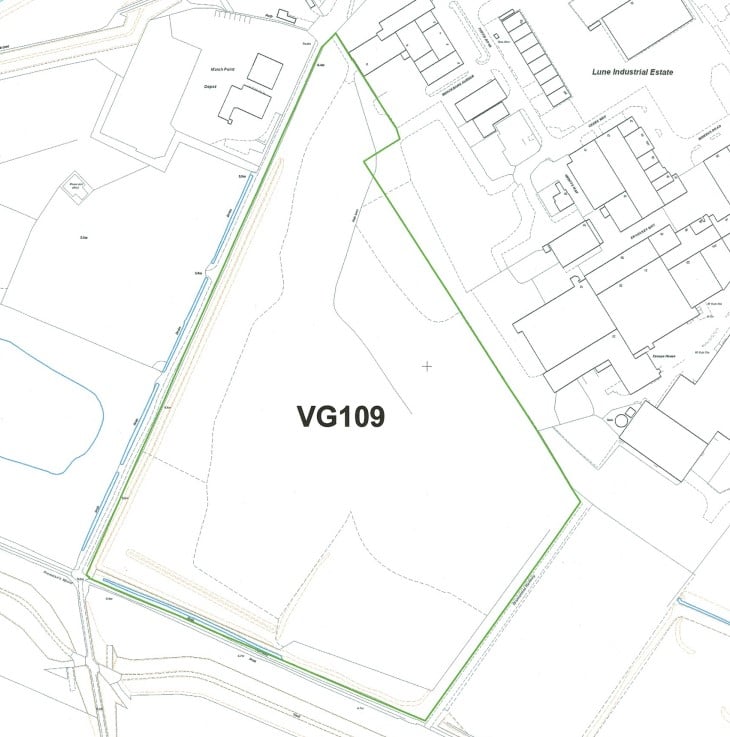
The majority of the land owned by Friends of Freeman’s Wood is designated as a Town Green under the 2006 Commons Act, Section 15 (the exception is the rectangular area of woodland bordering Coronation Field up to the line of the former Glasson railway track – shown in the South-East of the VG109 map below). Formal designation by Lancashire County Council for VG 109 (that’s us) was given on June 29th 2020. Achieving this status meant that the land was protected from development. It also directly led to FFW being able to purchase the land for a relatively very low fee in 2023 (£50k plus legal costs of around £10k). Below I describe some of the milestones in the eight-year journey to achieving this designation.
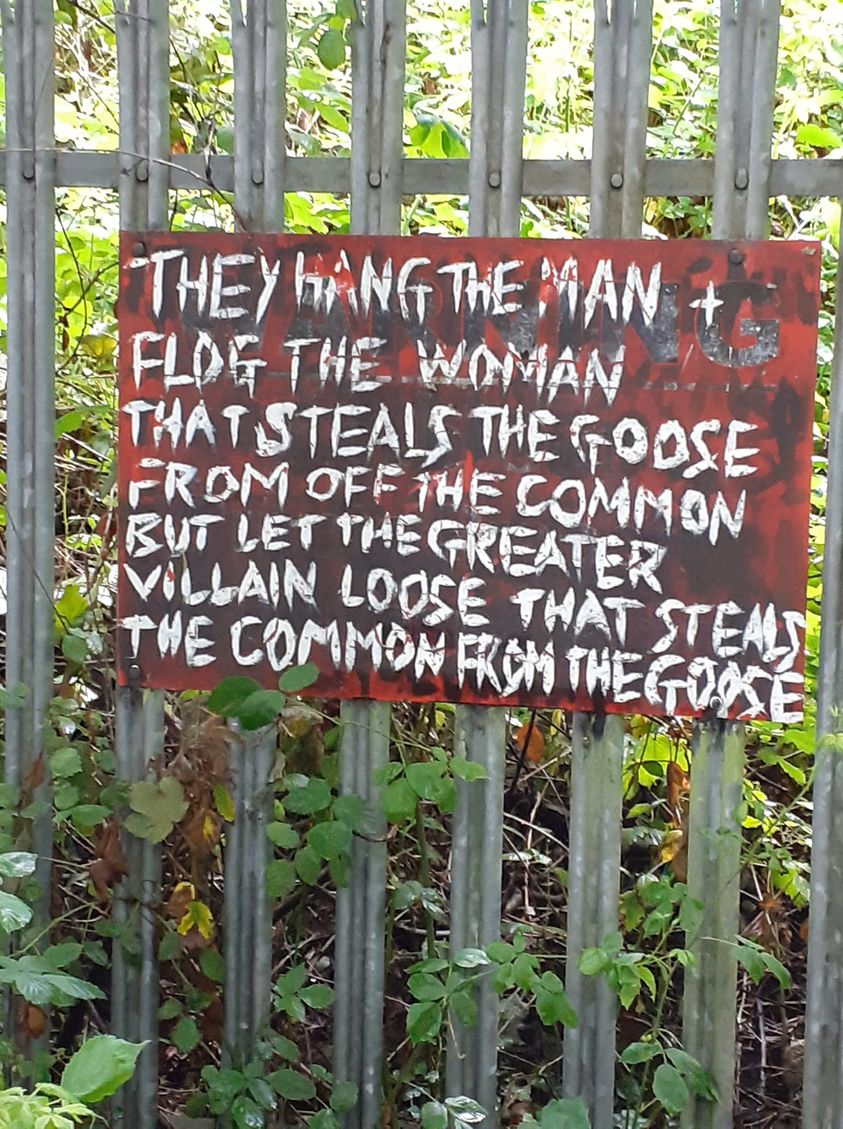
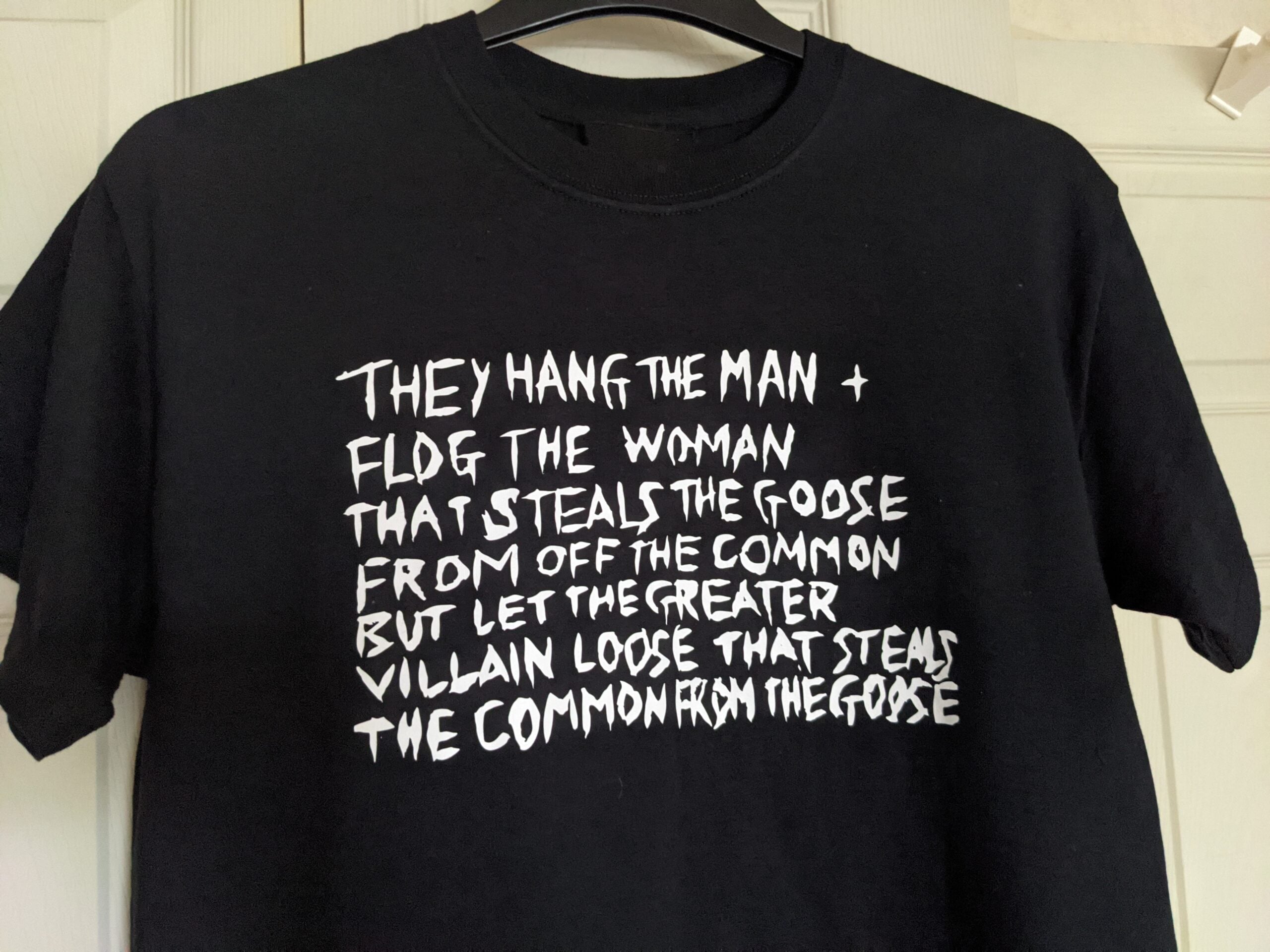
In December 2011, planning agents SATNAM Planning Services Ltd, arranged for a 6 ft metal fence to be erected around the site. One reason for this was that they had been contacted by local police following complaints by nearby residents about motorcyclists using the site. However, in general, Satnam wanted to secure the site to pave the way for a planning application for around 250 houses. Note that Satnam had been engaged by The Property Trust (via a satellite company Lune Industrial Estate Ltd) who were the owners of the site. Erection of the fence continued into early 2012. However, the fence erection was eventually stopped after Simon Gershon applied to the City Council for a blanket tree preservation order on the site. This was granted by the City Council and so construction of the fence had to stop – because trees needed to be uprooted to get the fence in place. However, by this time, the fence surrounded most of the site and it was difficult for people to enter (the unfenced part, along part of the cycle path boundary, was hard to enter because of dense scrub and trees). However, it was not long before parts of the fence mysteriously disappeared, and the site became porous again. There was also some interesting artwork including a version of The Goose and the Common poem (see picture). For a longer version see The Goose and the Common (unionsong.com).
The fencing also unleashed a flurry of other, defensive measures, by members of the local community and local councillors. An application for three footpaths across the site due to 20-year use was submitted by Emily Heath on behalf of Friends of Freeman’s Wood in summer 2012. Similarly, an application for the site to become a Biological Heritage Site was submitted by Simon Thomas. The footpath application was eventually passed by Lancashire County Council, but not until after FFW had bought the site. As far as we know, the Biological Heritage Site application is still sitting in the vaults at County Hall, Preston – waiting for somebody to process it. But the most important application was for Town Green Status for the land.
Town Green status
The key statement that needs to be satisfied is:
“a significant number of the inhabitants of any locality, or of any neighbourhood within a locality, have indulged as of right in lawful sports and pastimes on the land for a period of at least 20 years.”
Thus, in making the application you need to be sure that each part of that statement is satisfied. Firstly, we have to show that lots of people used the land from the locality. If you imagine a village green, then the locality is the village. However, we had to create a new Marsh ‘village’. We used the boundaries of the former Lancaster City Council Castle Ward prior to the 2003 local elections. Essentially, this is the area bounded by the centre of the river Lune, the A6, Aldcliffe Road and Aldcliffe Hall Lane. This is a big chunk of the west of Lancaster, including areas such as Fairfield, Portland Street, Abraham Heights, the Marsh estate, private housing on the Marsh, St George’s Quay. This locality is the same as the area of interest in the constitution of the Marsh Community Centre – thus providing a continuity with an important local institution.
We then obtained 70 statements and questionnaires from people who had lived in the locality and used Freeman’s Wood for lawful sports and past-times during the 20-year window that we were using (November 1st 1991 to November 1st 2011). This window was chosen so that it ended before the fencing started to go up. This was important because we also had to demonstrate the as of right part of the criteria. That is, that people thought they were allowed to use the land and that there were no indications to the contrary. Clearly, a sharp metal fence around the site does not suggest as of right! There was a weakness in our application because at one point during our time window, the owners put up notices to say to the effect of “Private – KEEP OFF”. We admitted this in our application but noted that very few people had seen these notices (they were dismantled fairly quickly by locals – some were used for air rifle target practice) and no attempt was made by the owners to replace them. There is some case law to suggest that putting up one set of notices is not enough to prevent as of right. Fortunately, the inspector agreed with us.
Our application for town green status remained in the queue at County Hall for quite a few years. We were in no particular hurry because we thought that it would have to be processed if the land was proposed for development. This proposal happened in 2017 when the planning agents Satnam put in details of a planning application for 250 houses on the site. This prompted us to get on to County Hall and for the application to be considered. We were eventually successful in getting this to happen.
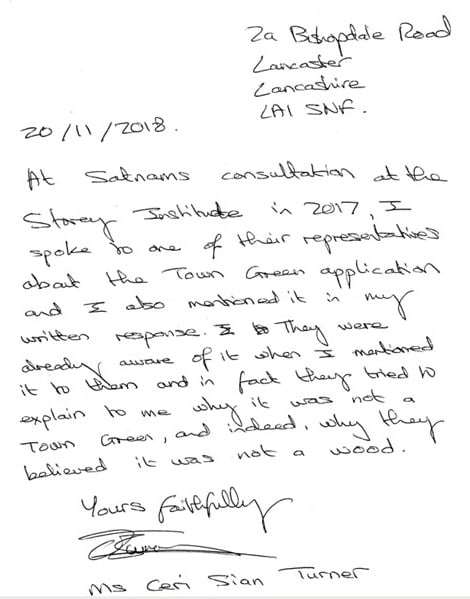
20/11/2018
At Satnam’s consultation at the Storey Institute in 2017, I spoke to one of their representatives about the Town Green application and I also mentioned it in my written response. They were already aware of it when I mentioned it to them and in fact they tried to explain to me why it was not a Town Green, and indeed, why the believe it was not a wood.
Yours faithfully,
Ms Ceri Sian Turner
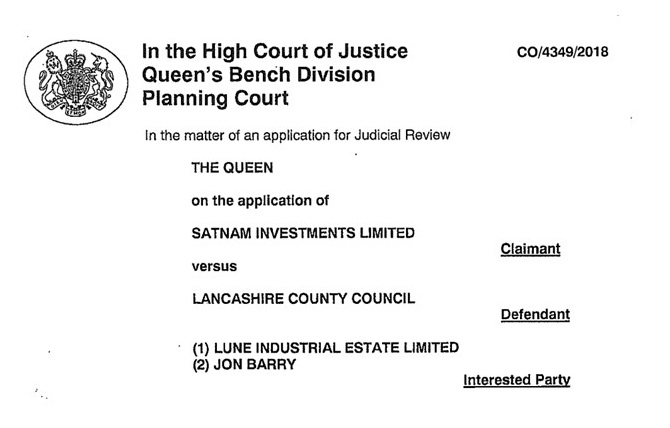
Satnam responded to activity on the town green submission by seeking a judicial review of the County Council’s role in processing the application. In particular, Satnam said that we had given false information on land ownership (we had put down The Property Trust as owners, whereas the land registration documents said that it was a company called Lune Industrial Estate Ltd – who are owned by the Property Trust!) and that the County Council did not inform the owners about the town green application until 2017. We were not represented at the first court hearing. However, worryingly, in December 2018 the judge granted Satnam’s request to take the matter to a judicial review of the application procedure. The case was to be heard in Manchester. If the case was lost, then our application would be invalid and we would have lost a key component in our fight to get Freeman’s Wood protected. Thus, at this stage, we sought legal advice from a barrister, Cain Ormondroyd.
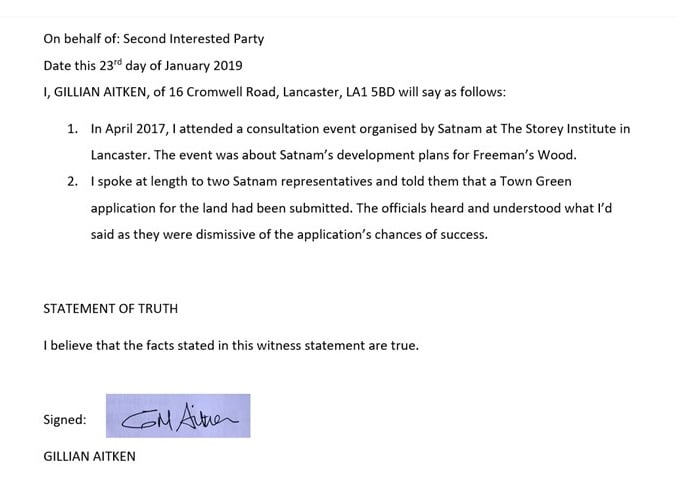
Part of our defence was showing evidence that we and the City Council had made Satnam aware of the Town Green application before they claimed to be first aware of it. We also included letters from Ceri Turner and Gill Aitken which said that they had talked to Satnam representatives at Satnam’s meeting at the Storey Institute about their proposed housing development. This meeting was in 2017, but the representatives were well aware of the Town Green issue then. – suggesting that they had known for some time. We also included a host of other information that showed that the information about the Town Green application was in the public domain well before 2017. This included Lancaster Guardian articles, the Landed art project, and six mentions in the newsletter Green View produced by local councillors.
We were all set to take part in the Manchester court case, when Satnam wrote to the County Council and said that they would withdraw their judicial review claim if the County Council speeded up their processing of the Town Green claim. The County Council agreed to this (we were of course delighted) and so the judicial review was dropped. I am sure that the new evidence that we presented was a major factor in this.
Town Green inquiry
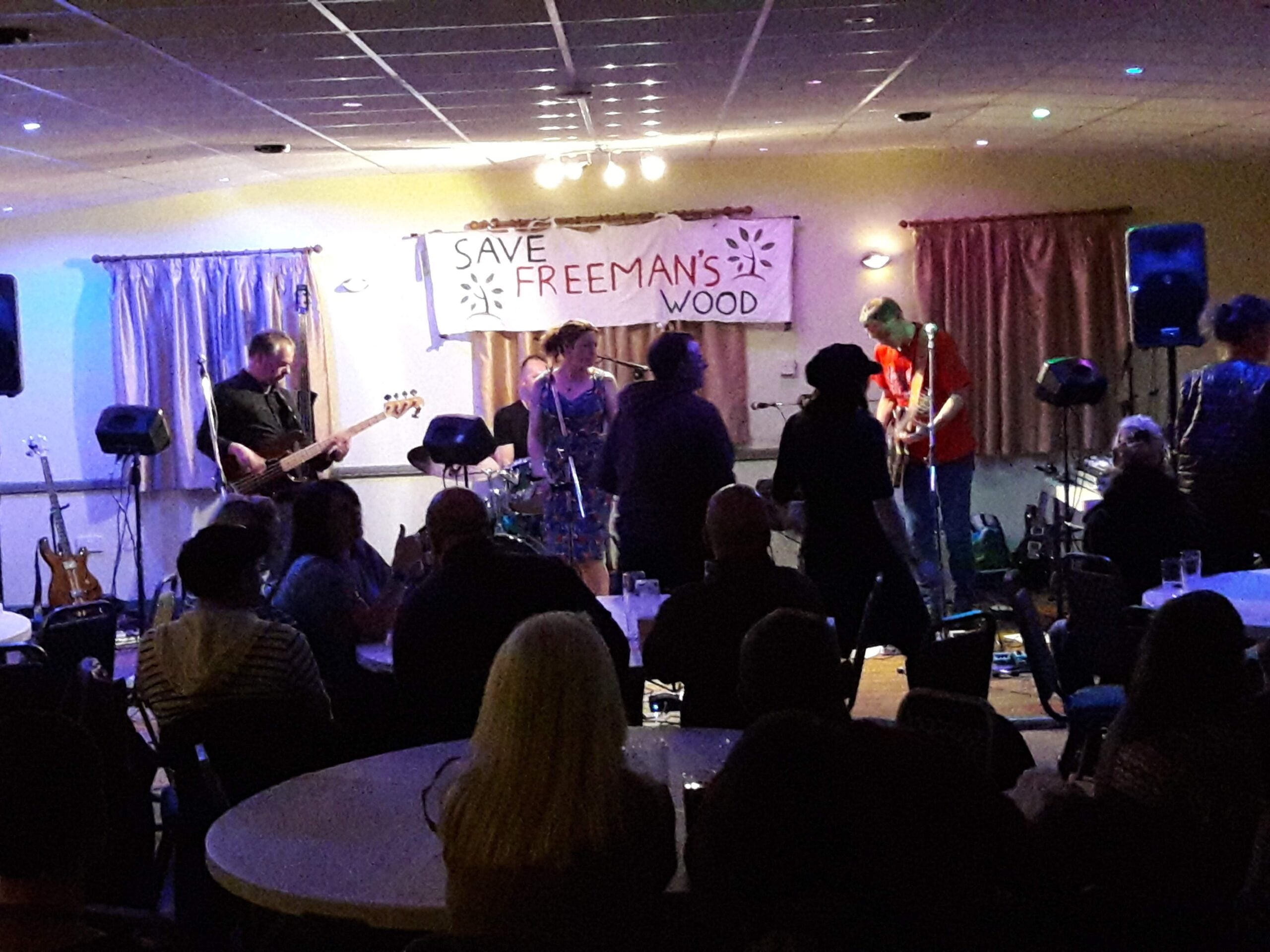
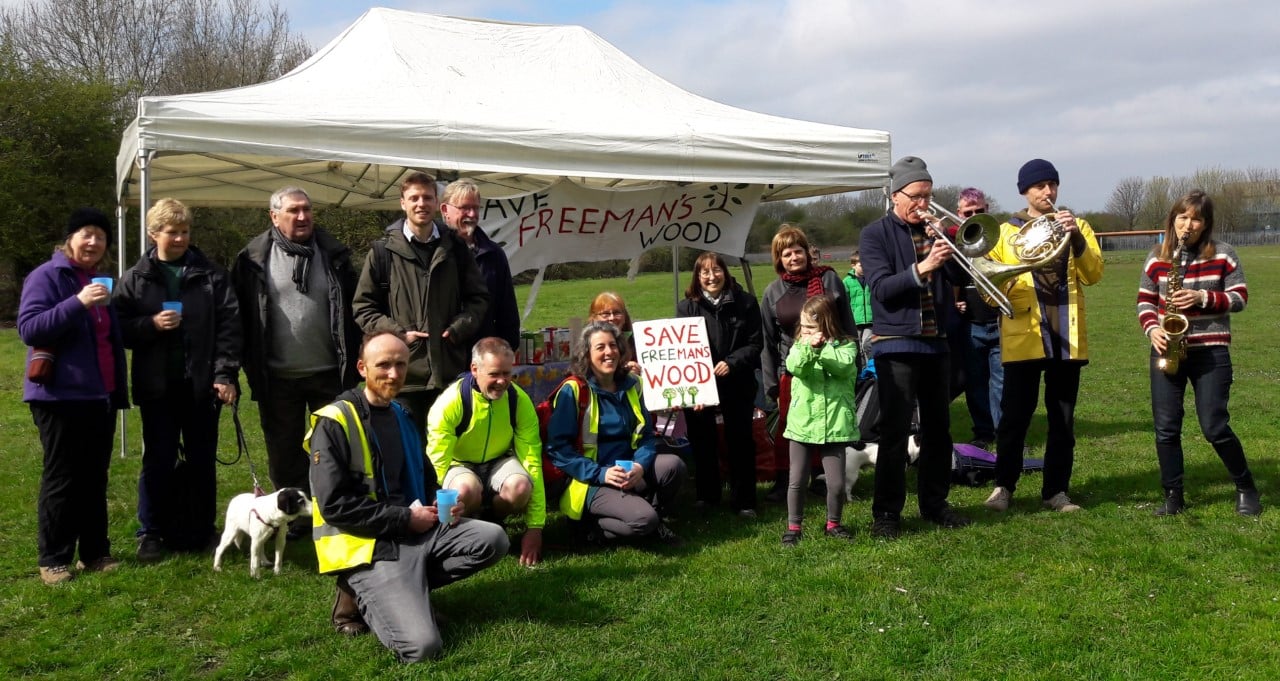
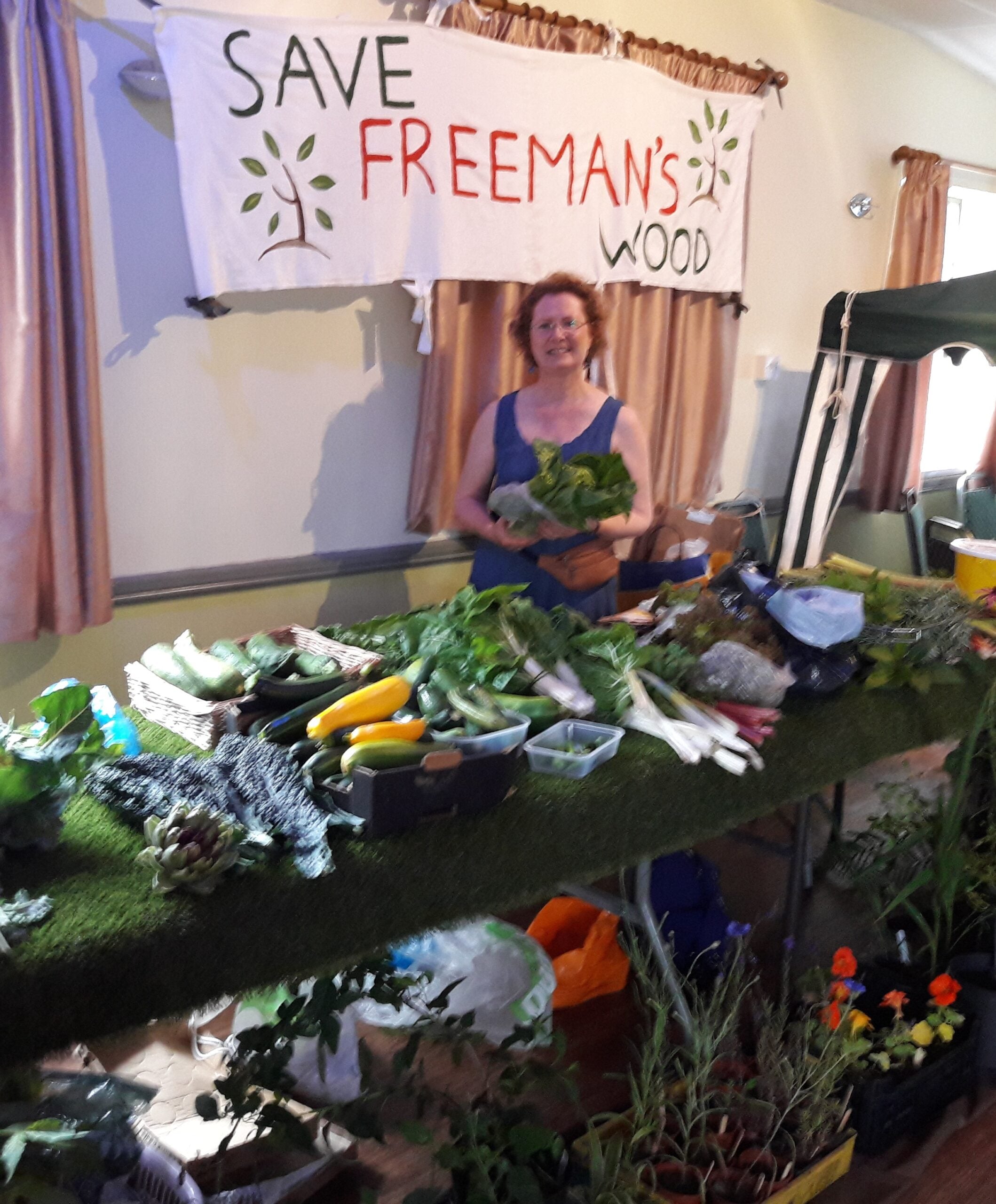
The Town Green inquiry finally took place in September 2019. We had again engaged Cain Ormondroyd to represent us at the inquiry. He had already had success in winning a Town Green claim for Barton Fields, another part of Lancaster. He was also originally a local resident of Lancaster and had attended Lancaster Grammar School. To pay our £17,000 legal costs, the local community made a huge and successful effort to raise the money. We asked for donations, sold t-shirts and did fundraising concerts (organised by Eleanor Levin) and jumble sales. We also received valuable monetary support from the Open Spaces Society – Protecting Open Spaces Since 1865.
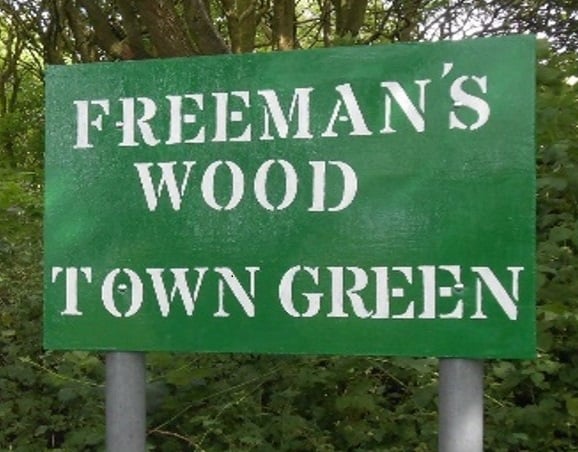
For the inquiry, 16 people agreed to attend as witnesses. Each of them had to make formal witness statements. These were in their words, with a few suggestions from Cain as to how to make them look more professional. Preparing for the inquiry was not easy. We had to create about five evidence bundles. These were large lever-arch files, full to the brim with documents and copies of photographs. They contained everything that we were to rely on at the inquiry: the statements and questionnaires from the 70 local inhabitants, the witness statements, our critiques of Satnam’s evidence. We had help from the Town Hall (I was a local councillor at the time and the City Council had expressed their support for the Freeman’s Wood campaign) and some expert filing and admin help from Sue and Doug Ashman.
Before the inquiry I also obtained valuable advice from Janine Bebbington, who had spear-headed the, at the time, successful Barton Fields application (which later lost at the supreme court). I also remember the day that Cain visited Lancaster to see the site for himself and to talk to as many of the witnesses as he could. I leant him a spare bike and we cycled to Freeman’s Wood and around the locality. Seemed fitting somehow.
Mistakes by Satnam
Satnam produced a huge lever arch folder of evidence supporting their claim. I spent a long-time poring over their evidence – and it soon became clear that what they had was either weak, wrong or had ‘shot themselves in the foot’. We set about finding the evidence to counter Satnam’s claims. However, Satnam had (kindly) included the best pieces of evidence themselves. These were two risk assessments carried out by independent observers in around 1997/8. Remember, these risk assessments were slap-bang in the middle of the 20 year period we were using to try to demonstrate Town Green status. They provided valuable evidence (to us!) about how the land was being used at the time:
"…due to the waste ground boundaries being unprotected and allowing open access to the public"
"…with large stretches of fence missing in many places. Consequently members of the public gain access to the land for recreational purposes."
"a model helicopter club regularly makes use of plot 2 (Freeman’s Wood) to fly model helicopters and planes"
We needed to show evidence that the land was being used ‘as of right, for lawful sports and past-times’ – and Satnam had just done that, on our behalf. They had provided evidence to corroborate what our witnesses and evidence were saying. This was a big own-goal for them. So why did it happen? How comes they did our job for us? Firstly, I’m sure that they didn’t mean to. And I’m certain that when their barrister at the inquiry saw what they had done, he would have nearly internally combusted (he came close to this a few times during the proceedings). Satnam had hired some solicitors from Manchester to produce the evidence. As everyone knows, solicitors are expensive and there would have been a limited budget. The only local knowledge on Satnam’s side was from David Cadman who had responsibility for the site during much of the 1991 to 2011 period. The solicitors would have asked him to go through the filing cabinet to come up with anything about the Freeman’s Wood site that demonstrated that they had been taking care of the site throughout the twenty-year period and hadn’t virtually abandoned it to the public (which is of course what they did do). The solicitors would have jumped at the idea of risk assessments being carried out – clearly demonstrating due diligence by the owners. The trouble from their point of view was that they either didn’t read the assessments (perhaps through lack of time) or, if they did, understand the bad (for them) consequences of the information they were presenting (lack of local knowledge). And perhaps they didn’t think that their opponents would make as much of the information as we did.
There were three other big issues that we were able to directly contradict Satnam’s evidence on.
They claimed that water pipes were dug across the land. We used some software used by Councils and the Utility companies called safedig (the clue is in the name). The newly-elected councillor for the Marsh area, Mandy Bannon, managed to get access to the software through the Council. I also remember her sitting on the wall outside the Town Hall on her mobile phone getting the password for us from safedig HQ. The software shows where all the pipes are buried. We were able to show (and provide a screenshot) that these pipes went along the cycleway at the border of Freeman’s Wood. Not a single pipe was in Freeman’s Wood!
Satnam also claimed that lino was still being dumped after 1991 (in the 20-year period). We looked at the history of Williamson’s and showed that lino production stopped in 1970!
Satnam also claimed (and they had an invoice) that a wooden fence had been repaired bordering the land. We were able to demonstrate (aided by a Google street view of the fence) that this fence was actually on another piece of land owned by Lune Industrial Estates Ltd and nothing to do with Freeman’s Wood.
Previous article